A Chiang Mai cooking class can begin with a basket of herbs at Warorot Market (Kad Luang), continue beside a garden kitchen outside the city, and end with a bowl of khao soi you have prepared yourself. The typical format combines ingredient selection, hands-on cooking and a shared meal, with many schools teaching four to six dishes such as curry, stir-fry, noodles, soup and mango sticky rice.
This guide is for food-focused travellers choosing between a convenient Old City half-day, a market-and-farm day, a Northern Thai menu or a higher-end hotel experience. It compares time, setting, transport, cost and accessibility, then explains what to check for vegan, vegetarian, halal and allergy-friendly cooking before you book.
Quick answer: For most food-focused travellers, a market-and-farm full-day class offers the fullest Chiang Mai experience, while an Old City half-day class suits a shorter itinerary. November–February is the best overall period for cooler, drier conditions; dietary substitutions and cross-contact policies should be confirmed in writing before booking.
What happens in a Chiang Mai cooking class?
The practical choice is straightforward: an in-town half-day class works best when your Chiang Mai itinerary is tight, while a market-and-farm full-day course gives food-focused travellers more context and a slower pace. A private or hotel-run session suits travellers who value privacy, service or a tailored menu over the lowest price.
A typical Chiang Mai cooking class starts with a market or ingredient introduction, followed by choosing and preparing produce, hands-on cooking and a shared meal. Many schools teach four to six dishes, often combining curry, a stir-fry, noodles, soup and mango sticky rice; some include khao soi, the Northern Thai noodle dish. Classes frequently pair Northern specialties with central Thai recipes, so check the menu rather than assuming every course is specifically Lanna cooking. OutThailand’s 2026 guide describes this market-to-meal format and the usual multi-dish structure.
| Format | Typical duration and setting | What you may cook | Best for | Trade-off |
|---|---|---|---|---|
| Half-day shared class | About three to four hours; usually an in-town kitchen | A compact selection of curry, stir-fry, noodles, soup or dessert | Short stays, evening plans and travellers staying around the Old City | Less time for market context, regional detail and relaxed cooking |
| Full-day market-and-farm class | About five to eight hours; market visit followed by a garden or farm kitchen | Several dishes, often including curry paste, a noodle dish and dessert | Food travellers who want ingredients, scenery and a deeper practical lesson | Uses most of a day; outdoor ground may be uneven and weather can affect the experience |
| Private or hotel-run session | Flexible timing; hotel kitchen or more controlled private setting | A set or bespoke menu, depending on the provider | Couples, small groups and travellers prioritising privacy or service | Usually costs more, and the market element may be limited or absent |
Printed recipe booklets are commonly provided, which makes a class more useful after the trip than a meal alone. Full-day farm formats generally start with morning pickup and return in the middle or late afternoon, while half-day schedules leave room for another market, temple or meal.
Diet requires an explicit check before payment. Vegetarian and vegan menus are often possible when requested in advance, but each school sets its own policy; fish sauce and shrimp paste may otherwise appear in sauces or curry paste. Travellers requiring halal food or managing a severe allergy should send the requirement in writing and ask about substitutions and cross-contact procedures. The Rice Barn’s course information and allergy guidance cited by travel sources support confirming these details directly rather than relying on a generic “dietary options” label.
Where to take a class: Old City, markets, farms or hotels?
Old City and in-town kitchens

Choose an Old City class when convenience matters more than the countryside. In-town schools such as Asia Scenic Thai Cooking School suit travellers with a tight itinerary, and comparable structured kitchens commonly offer half-day or evening formats lasting around three to four hours. A typical menu covers several dishes rather than one demonstration: curry, stir-fry, noodles, soup, mango sticky rice or, in some classes, khao soi. Asia Scenic also highlights Northern Thai selections alongside more widely known central Thai dishes.
This format is the practical choice after arriving through Chiang Mai International Airport, before an evening train, or for anyone who does not want a full day devoted to cooking. It is also easier for travellers who prefer firm floors, short transfers and a predictable indoor setting. Check the school’s current address and accessibility details if stairs, standing time or kitchen layout could affect your participation.
Market-based classes
A market visit gives the class more local context: you see the herbs, vegetables, curry ingredients and prepared foods before selecting what goes into the lesson. Some itineraries use Somphet Market; others may visit Warorot Market (Kad Luang), a working city market associated with produce, herbs and street food. It is a more useful choice than a purely staged “market tour” for food-focused travellers, but arrangements vary, so confirm the market, meeting point and sequence with the school rather than assuming every class visits the same place.
Warorot can be crowded and retains the character of a working market. Travellers with respiratory sensitivities should plan appropriate precautions, and anyone wanting a quieter, less mobile morning may prefer an in-town class without the market component. The market walk can also add practical standing and uneven surfaces before cooking begins.
Farm cooking schools outside the city
For the fullest Chiang Mai cooking-class format, compare Thai Farm Cooking School, Rice Barn Thai Cooking Farm, Mama Noi Thai Cookery School and Grandma’s Home. These schools are typically around 17–30 minutes outside the city and combine a market stop with ingredient preparation, hands-on cooking and a garden or farm setting. A full-day programme generally takes around five to eight hours, often with pickup in the morning and a return in the middle or late afternoon.
The garden atmosphere suits travellers who want to identify ingredients and cook several dishes at an unhurried pace, including a possible Northern speciality such as khao soi. The trade-off is transfer dependence: pickup zones and times must be confirmed, and outdoor kitchens may have uneven paths. Contact the school before booking if you use a wheelchair, walk with difficulty or need to limit standing.
Hotel-run cooking
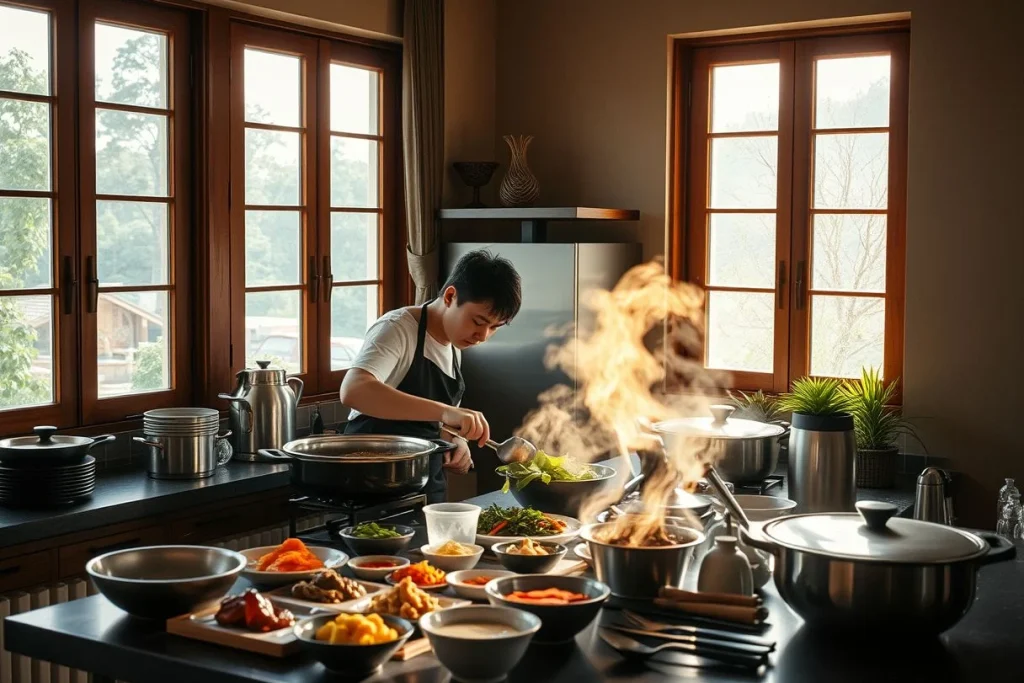
Anantara Chiang Mai’s Spice Spoon is the higher-end alternative for travellers prioritising service, privacy or a polished setting over the lowest price. Its cited brochure is from August 2022, not a 2026 quotation, so treat it as a style reference and request the current menu, format and price directly. This option makes sense for a private-style experience or a special occasion; a shared farm class offers more market and garden context for travellers mainly interested in ingredients and value.
When to go: weather, crowds and seasonal events
For the most comfortable Chiang Mai cooking-class experience, choose November to February. The cool, relatively dry season makes a market visit and time in a farm kitchen easier, while produce and herbs are varied. It is also the period when demand is high, so compare menus and reserve earlier than you would in quieter months. Chiang Mai’s provincial guide describes this as the city’s main cooler travel season (2026).
March to May is hotter, particularly for outdoor farm formats. Mid-April brings Songkran, when water celebrations can affect local transport and some businesses’ schedules; check the current festival dates and ask the school whether pickups and classes run normally before committing to those dates.
July to October is wetter. A farm class can still be rewarding, but paths and outdoor work areas may become muddy, and the school may need to adjust the itinerary. An indoor Old City class is the safer choice if rain would disrupt your plans, though market visits can still mean crowded, working conditions; travellers with respiratory sensitivities should take suitable precautions.
June, July and August are listed among the supplied peak months, but they share the wetter-season trade-off rather than December’s cooler, drier pattern. December combines favourable weather with strong demand. Before booking, verify the forecast, current event arrangements, class availability, menu and price directly with the school; seasonal weather and outdoor operations can change at short notice.
How to book and get there
Start by comparing the class itself, not just the headline menu. Check the exact dishes, whether the itinerary includes a market visit, class length, group size, recipe-booklet language and what is included in the quoted price. For a food-focused itinerary, confirm whether the menu includes Northern specialities such as khao soi, rather than only central Thai staples.
Dietary details need to be agreed before payment. Vegetarian and vegan menus are often possible when requested in advance, but policies differ between schools; travellers with severe allergies should confirm substitutions and cross-contact procedures in writing. Fish sauce and shrimp paste can appear in Thai cooking, so do not assume that a dish is allergy-free because meat has been removed. Ask the same question about halal preparation.
Booking direct with a named school is usually the clearest route for complex allergies, mobility requirements or a private menu. Compare Thai Farm Cooking School, Rice Barn Thai Cooking Farm, Mama Noi Thai Cookery School, Grandma’s Home and Asia Scenic Thai Cooking School, then request the pickup zone, meeting point, cancellation terms and final start time in writing. A reputable booking platform can be convenient for straightforward reservations, but check that its menu and transfer information match the school’s own details.
Farm courses commonly include hotel pickup and drop-off only within stated areas. Thai Farm Cooking School’s published full-day information indicates that collection may fall around 8am–9am, with return in the middle or late afternoon, although the operator sets the final schedule. Allow extra time: farm schools are generally outside the city, while Old City classes are easier to reach independently on foot, by Grab, songthaew or tuk-tuk. Confirm the exact meeting point rather than assuming pickup from Chiang Mai International Airport is available; airport transport should be arranged separately unless the school explicitly accepts it.
Independent travel is most realistic for an in-town class. For a farm kitchen, book transport only after confirming the location, and tell the school about luggage, mobility aids or a tight onward connection. Outdoor kitchens can have uneven ground, so contact the operator before booking if access is important. Reserve ahead for high-demand periods, then reconfirm the menu, pickup, weather-sensitive arrangements and cancellation policy shortly before the class.
Cooking class costs in Chiang Mai: 2026 estimates
Cooking class costs in Chiang Mai: 2026 estimates

In Chiang Mai, cooking class prices depend mainly on duration, transport and privacy. The following are estimated costs checked against July–September 2026: OutThailand’s 2026 guide supplies the shared-class ranges, while the hotel-run figure is an older indication rather than a current quote.
| Estimated costs: Chiang Mai cooking classes | |
|---|---|
| Tier | Approximate price per person |
| Budget: shared half-day | ฿750–฿1,000 |
| Mid-range: shared market-and-farm full day | ฿1,000–฿1,800 |
| Luxury: private or hotel-run experience | From about ฿2,500; higher prices are possible |
Basis: shared half-day estimates are from OutThailand’s guide, checked July 2026; full-day estimates are from the same guide, checked July–September 2026. The luxury indication comes from Anantara Chiang Mai’s Spice Spoon brochure dated August 2022, so it must be rechecked for 2026.
A half-day class usually covers the cooking session and shared meal. Before paying, confirm whether the price also includes a market visit, ingredients, recipe booklet or hotel transfer. Full-day market-and-farm courses generally cover the market or garden component, cooking and a meal; many operators include pickup within a stated zone, but you’ll still need to confirm the pickup boundary and every other inclusion.
Private chef sessions and hotel classes cost more because they may provide a bespoke menu, a smaller group or a more polished setting. Promotions, private supplements, transfer distance and exchange rates can change the final amount.
For the live price, menu, pickup terms and cancellation policy, check the school’s current booking page or contact the operator directly.
| Item | Budget | Mid-range | Luxury |
|---|---|---|---|
| Shared half-day cooking class | ฿750–฿1,000 per person | — | — |
| Full-day market-and-farm cooking class | — | ฿1,000–฿1,800 per person | — |
| Private or hotel-run cooking experience | — | — | From about ฿2,500 per person, with higher prices possible |
Estimated ranges based on the sources listed below. Prices change; check with providers before booking.
Practical tips for choosing the right class
- Put dietary requirements in writing. Message the school with every allergy, vegan or vegetarian requirement, halal need and cross-contact concern before paying. Ask specifically whether fish sauce, shrimp paste, oyster sauce, stock and shared utensils can be excluded; schools differ, and severe allergies require a written substitution policy rather than an assumption. Rice Barn’s course information is a useful example of the detail to check.
- Confirm the menu, especially for Northern dishes. Khao soi is associated with Chiang Mai, but it is not guaranteed on every class menu. Ask which dishes you will cook, how many there are and whether substitutions change the menu; classes commonly cover four to six dishes, including curry, stir-fry, noodles, soup or mango sticky rice.
- Choose clothing for a working kitchen. Wear breathable clothes, secure long hair and use closed-toe shoes. Covered shoulders or knees are sensible where the class visits a market or follows local site etiquette; bring sun protection and water for outdoor farm kitchens.
- Allow for market conditions. Warorot Market (Kad Luang) and other wet markets are working food markets, not quiet demonstrations. Crowding is possible, so travellers with respiratory sensitivities should plan appropriate precautions, and anyone carrying a daypack should keep it compact.
- Check the ground before choosing a farm. Outdoor kitchens can have uneven paths and limited accessibility. Contact the school before booking if you use a wheelchair, have balance concerns or need to avoid steps; an Old City or indoor class may be the more practical choice.
- Match the format to the weather. During heavy rain, ask whether the farm itinerary can change and consider an in-town class with more indoor cooking. Farm-school programmes commonly run for much of the day, so allow extra time for wet roads and pickup delays.
- Verify transport twice. Hotel pickup is often limited to specified zones, with the exact meeting time confirmed by the operator. Recheck the pickup address and return time, and do not schedule a class immediately before a fixed departure from Chiang Mai International Airport.
- Copy and send this five-question message: “Can you accommodate my dietary requirements and prevent cross-contact? Will fish sauce, shrimp paste, oyster sauce, stock and shared utensils be excluded? Is khao soi on this day’s menu? Is hotel pickup available from my address, and what are the pickup and return times? What is your cancellation policy if weather affects a farm visit?”
Which format should you choose?
Choose an Old City or in-town half-day class if convenience matters most: it typically takes around three to four hours and suits a tightly planned itinerary or an evening activity. Asia Scenic is one in-town option with multi-dish menus and Northern Thai selections.
For food-focused travellers, a market-and-farm full-day class is the stronger choice. Thai Farm Cooking School and Rice Barn combine ingredient shopping with garden-based cooking, giving you more context for dishes such as khao soi; full-day formats generally take five to eight hours, according to OutThailand’s 2026 guide and the schools’ published course information.
Choose a private or hotel-run experience, such as Anantara Chiang Mai’s Spice Spoon, when tailored dishes, comfort or higher service outweigh budget. Shortlist two operators, send the dietary and pickup questions above, verify live 2026 details, then book the format that fits your itinerary.
Frequently asked questions
Do I need previous cooking experience to join a class in Chiang Mai?
No previous experience is identified as a requirement in the available class information. The usual format is guided, hands-on cooking after ingredient selection, with instructors leading several dishes and a shared meal afterwards. Class structures vary, so beginners should confirm the teaching format directly with the school before booking. The Chiang Mai Cooking Class 2026 guide describes courses as practical sessions rather than advanced training.
What should I wear for a Thai cooking lesson?
The supplied sources do not specify a universal dress code, so check the school’s instructions before you go. Practical clothing is sensible for a hands-on lesson, and a farm course may involve outdoor areas and uneven ground. The Rice Barn Thai Cooking Farm and Thai Farm Cooking School materials indicate that farm settings form part of some full-day itineraries; contact the operator if mobility or footwear is a concern.
Can children take part in Chiang Mai cooking classes?
The available sources do not give a consistent minimum age or confirm that every school accepts children. Ask the individual operator about age limits, supervision, workstation height and whether a child needs a paying place. This is particularly important for full-day farm courses, which can last about five to eight hours and may include outdoor, uneven areas, according to Thai Farm Cooking School information.
Are recipes usually provided in English?
Printed recipe booklets are commonly provided for travellers to take home, according to the Chiang Mai Cooking Class 2026 guide. The available information does not guarantee that every booklet or demonstration is in English, however. Confirm the recipe language when booking, especially if you want to recreate dishes such as curry, stir-fry, noodles, soup, mango sticky rice or khao soi after the class.
Will every class teach khao soi?
No. Khao soi is commonly included among the dishes taught in Chiang Mai, and local schools often combine Northern specialities with central Thai recipes, but the menu differs by operator and course. Asia Scenic Thai Cooking School lists Northern Thai selections, while the broader Chiang Mai class guide describes menus of around four to six dishes. Check the exact day’s menu if khao soi is your priority.
Can I join a class if I am travelling alone?
A solo traveller can consider a shared class, since the typical format involves hands-on cooking followed by a shared meal and many courses are sold for group participation. The supplied sources do not confirm minimum group sizes, guaranteed departures or solo supplements, so ask the school before paying. Also confirm pickup arrangements: farm operators commonly serve specified hotel zones, but the exact location and time must be checked directly.