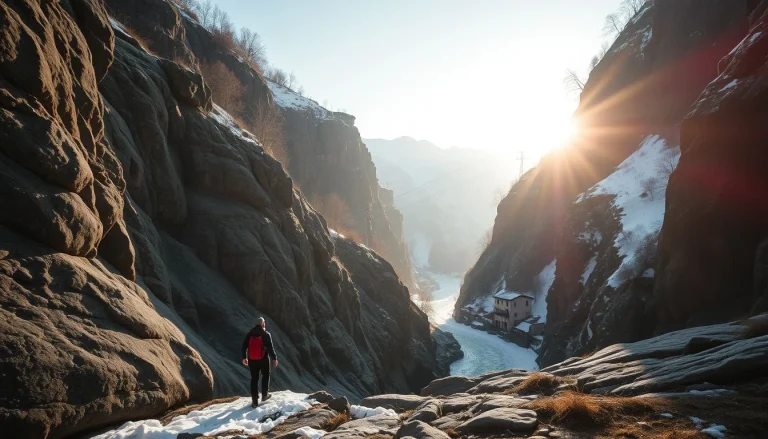
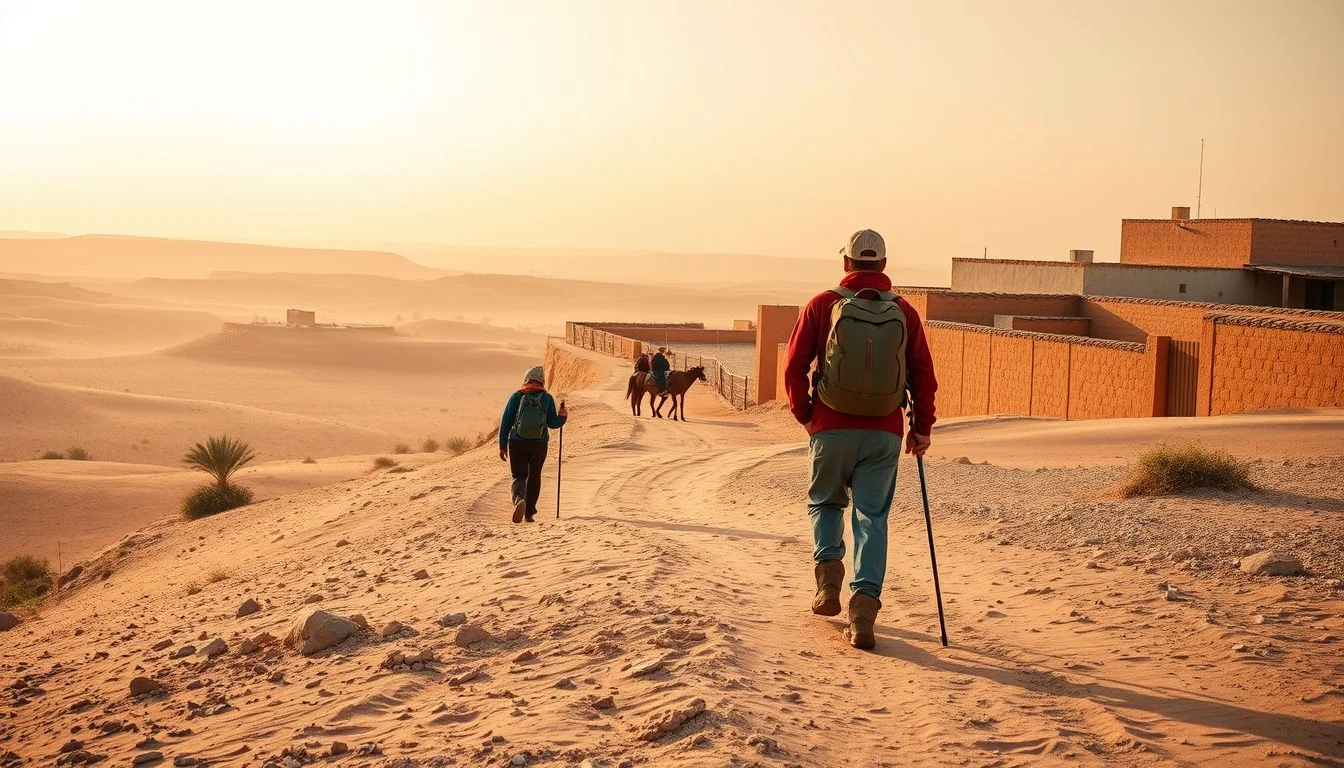
At Erg Chebbi, the dunes near Merzouga rise to roughly 150 metres, with paved-road access, camps and short camel excursions close at hand. Farther west, Erg Chigaga demands an unpaved 4×4 approach from M’Hamid; in Tunisia, the route from Douz towards Ksar Ghilane trades towering dunes for a longer, supported desert journey.
This Sahara trekking guide is for adventure travellers planning anything from a one-night camel-and-bivouac stay to a multi-day walking expedition. Use it to choose between accessible Merzouga, more remote Erg Chigaga and supported Tunisian routes, then judge the effort, water plan, gear, guide arrangements and insurance before committing. The Sahara is not one uniform landscape: sand seas, stony plains, rock plateaus and salt pans bring different demands, while heat, cold nights and limited medical infrastructure make preparation part of the route.
Quick answer: First-time visitors should usually choose an organised Merzouga and Erg Chebbi camp experience, a guided Erg Chigaga trek from M’Hamid, or a supported Douz–Ksar Ghilane route. Travel in spring or autumn, plan about 3–4 litres of water capacity per person per day, and confirm the operator’s route, emergency evacuation, insurance and camp arrangements before booking.
Why trek the Sahara? Three ways to experience the desert
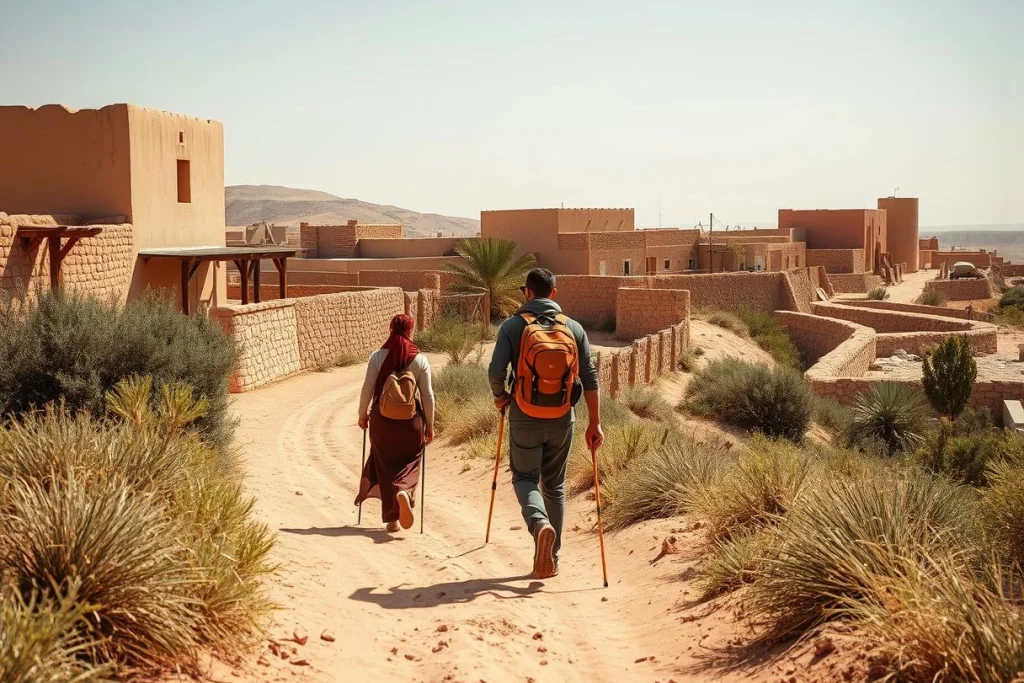
The Sahara earns its place on an active itinerary at first light, when the sand is cool beneath your boots and the dunes hold long blue shadows. Later, an Erg Chebbi ridge turns gold at sunset; after dark, a bivouac sky replaces the road, followed by tagine, dates and mint tea around camp. The appeal is not simply scenery, but the rhythm of moving, stopping and sleeping in a landscape with few visual distractions.
There are three useful ways to approach Sahara trekking. The accessible choice is a Merzouga or Erg Chebbi sunset camel ride with an overnight camp: it gives first-time visitors a taste of desert travel without demanding much fitness. A more active option is a guided circuit around Erg Chigaga from M’Hamid, or between Douz and Ksar Ghilane in Tunisia, with more walking and greater emphasis on logistics. At the high-comfort end, a supported expedition pairs longer days in the desert with private transport, carefully arranged camps and a guide managing the practical details.
Do not picture one uniform sea of sand. The Sahara also includes stony plains, rock plateaus and salt pans, each changing the footing, scenery and navigation demands, as research published through Wiley’s Journal of Geophysical Research: Earth Surface explains. A short camel-and-camp outing is a different undertaking from multi-day foot trekking, which brings strenuous sand walking, heat exposure and water planning. Choose established southern Moroccan or Tunisian circuits rather than assuming every region is accessible: the US Department of State warns against many long-distance desert trips and border crossings in Algeria, while cited UK Foreign Office advice warns against travel within 40km north and west of the Western Sahara Berm.
Best Sahara trekking routes: choose by difficulty and desert scenery
Sahara trekking is not one route or one kind of terrain. Sand seas, stony plains, rock plateaus and salt pans change the effort, navigation and sense of isolation; choose the landscape first, then the distance. The most practical, widely serviced areas are southern Morocco’s Erg Chebbi and Erg Chigaga, and southern Tunisia’s Douz–Ksar Ghilane and Tozeur regions.
| Route | Gateway | Typical duration | Terrain and effort | Remoteness | Best use |
|---|---|---|---|---|---|
| Merzouga and Erg Chebbi | Merzouga | One night to several days | Large dunes; easy to moderate, depending on walking | Low | First Sahara trip, sunset camel ride and camp |
| Erg Chigaga | M’Hamid | Two to four days | Dunes and open desert; moderate to strenuous | Higher | Quieter Moroccan route with mixed walking and 4×4 support |
| Zagora | Zagora | Short excursion to a few days | Accessible desert terrain; easy to moderate | Low to moderate | A shorter introduction when time is limited |
| Douz to Ksar Ghilane | Douz | Two to four days | Sand and open desert; moderate | Moderate | Tunisian camel trek ending at an oasis |
| Tozeur and Chott el-Jerid | Tozeur | Short visit to a wider itinerary | Salt-pan and mixed desert landscapes; easy to moderate | Low to moderate | Landscape-focused travel rather than a pure dune traverse |
| Moroccan deep-desert circuit | Route-specific | Five to 14 days | Extended sand and mixed terrain; strenuous | High | Experienced trekkers with professional logistics |
Erg Chebbi is the straightforward choice for a first Morocco desert trek. Its dunes rise to roughly 150 metres, roads reach Merzouga, and the dense camp network makes a one-night camel-and-bivouac trip simple to arrange. It offers the clearest introduction, but also the least solitude. The route’s accessibility and dune profile are described by Morocco Travel Base and MoroccoMag.
Choose Erg Chigaga when remoteness matters more than convenience. From M’Hamid, the approach requires an unpaved 4×4 journey, after which a two- to four-day itinerary can combine walking, vehicle transfers and camp nights. It suits a traveller who wants more open space and a stronger expedition feel without committing to a long unsupported crossing; confirm seasonal camp operation and transport access for your dates.
Zagora is the practical compromise for a shorter southern Morocco itinerary, although its dunes are less dramatic. In Tunisia, Douz to Ksar Ghilane gives a similar multi-day structure with camel trekking, bivouacs and an oasis finish, best planned in the cooler part of the year. Tozeur and Chott el-Jerid are better for salt-pan scenery and broader desert exploration than continuous dune walking.
Five- to 14-day Moroccan foot or camel circuits belong to experienced trekkers using professional navigation, provisions and support. For most first-time visitors, choose Merzouga in spring or autumn for access and simplicity; choose Erg Chigaga if you accept the longer 4×4 approach in exchange for a wilder setting. Any itinerary near Algeria, a border or the Western Sahara Berm needs a separate check of current official advice and route restrictions before booking.
Sahara desert trekking difficulty: fitness, water and safety
How hard is Sahara trekking?
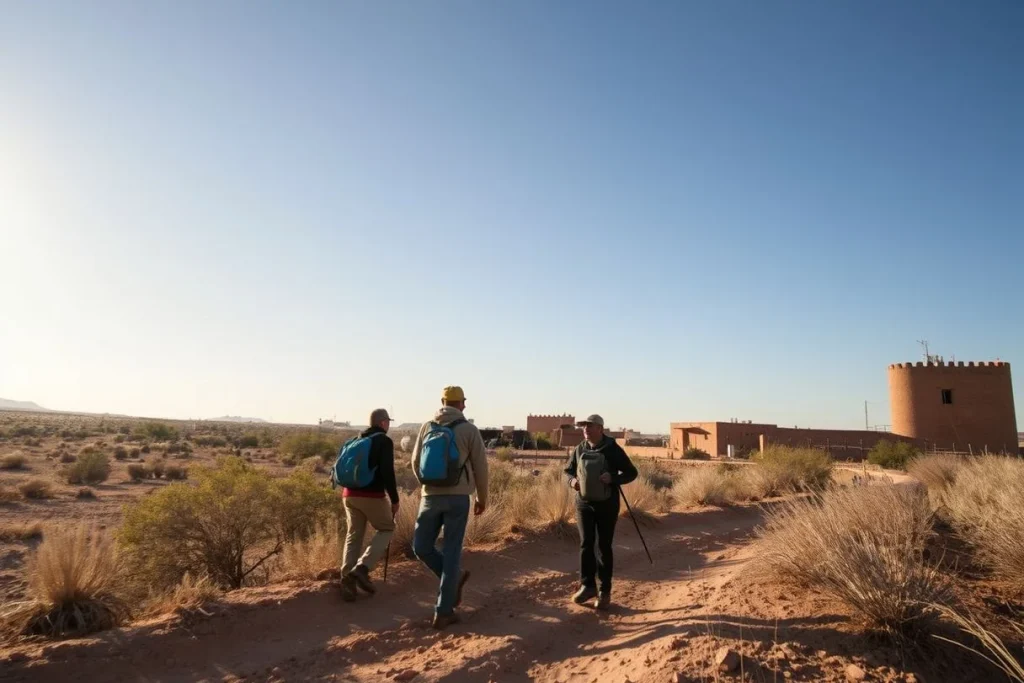
The effort depends less on the headline distance than on the ground beneath your boots. A sunset camel ride and one night at a camp require relatively little fitness. Repeated dune walking is moderate, while a multi-day foot trek becomes strenuous: soft sand slows every step, uphill progress on dunes is tiring, and heat adds to the load. The Sahara also includes stony plains, rock plateaus and salt pans, each with different walking and navigation demands.
Use this practical scale when choosing a route. Easy suits a Merzouga camel-and-camp itinerary. Moderate fits repeated dune walks or a two-day supported route. Strenuous means several days on foot with equipment, food and water logistics. Expedition-level describes remote or unsupported circuits, which require experienced trekkers and professional navigation and support.
Prepare with long walks on uneven ground and occasional hills, then repeat them with a loaded daypack. Sand walking is slower and more tiring than the same distance on a firm trail, so judge a proposed itinerary by walking hours, terrain and support rather than kilometres alone.
Water, heat and daily routines
Plan approximately 3–4 litres of water capacity per person per day. Ask the operator exactly who supplies, carries and replenishes it; for any unsupported section, confirm the resupply or purification plan in advance. Start early, walk in shade where possible and schedule a proper midday rest rather than trying to push through the hottest hours.
Interior Saharan zones can exceed 40–45°C in summer. Headache, dizziness, nausea, unusual weakness or confusion should end the walk: move the affected person into shade, cool them and follow the guide’s emergency procedure. Use a buddy check throughout the day, and agree what happens if someone becomes ill, a sandstorm arrives or the group is separated. Do not wander alone, even near camp; keep to the guide’s navigation system and regrouping instructions.
Medical and route-specific risks
Desert medical infrastructure is limited, so travel insurance with remote-area medical evacuation is strongly recommended. Confirm that the policy covers every country and activity on the itinerary, and ask the operator how an extraction would work, which communications are available and where the nearest treatment point is. The cited Morocco travel guidance from the US Department of State also recommends checking current advice on hepatitis A, typhoid and routine adult vaccinations.
These precautions matter most beyond mainstream southern Morocco and Tunisia circuits. The US Department of State’s Algeria advisory warns against many long-distance overland desert trips and border crossings because of kidnapping and terrorism risks. The cited UK Foreign, Commonwealth and Development Office advice warns against travel within 40 km north and west of the Western Sahara Berm. Check current official advice and the precise route before paying a deposit.
Sahara trekking packing list: what to bring or rent
Pack for the desert’s extremes, not just its daytime photographs. Start with a day bag containing 3–4 litres of personal water capacity per person per day; confirm whether the operator supplies water, and carry purification tablets or agree a resupply plan for any unsupported section. A cited Morocco travel advisory also recommends checking current advice on hepatitis A, typhoid and routine adult vaccinations before departure.
Essentials and clothing
- Take a wide-brimmed sun hat, sunglasses, high-SPF sunscreen and lip balm. A scarf or buff protects your face from sun and blowing sand.
- Choose breathable long-sleeved layers and loose trousers rather than shorts. Add a fleece or insulated jacket for winter nights: interior Saharan temperatures can fall close to freezing, despite warm days.
- Wear broken-in, closed footwear with secure socks. Trekking poles can help on soft dunes, where every step sinks; pack blister plasters and basic first aid.
- Carry a headlamp, spare batteries or a power bank, personal medicines, snacks, toilet paper, hand sanitiser and a small hygiene kit. Earplugs are useful in shared camps.
- Use a dry bag or sealed pouch for electronics, documents and spare clothing. Keep photocopies or offline copies of your passport, insurance details and prescriptions.
Sleep and luggage
Ask before departure exactly what the camp provides: tent, mattress, bedding, sleeping bag, towels, charging and drinking water. For a winter camp, do not assume supplied bedding is warm enough; confirm the sleeping-bag requirement and bring insulated layers. On a supported expedition, ask who carries tents, cooking equipment and shared water, and what weight limit applies to luggage or camel loads.
Separate a small day bag from the main luggage left in a 4×4 or at camp. Keep water, sunscreen, layers, medicines and documents with you rather than in the vehicle. Check whether rental footwear, sleeping bags, poles or packs are available, and test any rented equipment before leaving the gateway town.
Before you leave
Confirm charging arrangements, luggage limits, toilet facilities and the procedure for a sandstorm or sudden route change. Some camps operate seasonally or reduce services during extreme heat, so verify availability for your dates. For remote travel, insurance should cover the exact countries, activities and medical evacuation; desert regions have limited medical infrastructure, according to the cited U.S. Embassy Morocco guidance.
Guided or independent in the Sahara: the safer trade-off
For most international visitors, a guided Sahara trek is the sensible choice. A shared three-day Marrakech–Merzouga circuit keeps logistics simple: transport, a camp night and a camel ride are usually bundled, but the long road days and fixed itinerary leave little room for walking beyond the organised stops. A private or small-group trip costs more, yet gives you greater control over walking time, camp style and rest breaks.
For genuine multi-day walking, use a specialist expedition operator rather than treating a tourist circuit as a trek. Erg Chigaga from M’Hamid, or a Tunisian route between Douz and Ksar Ghilane, needs a planned water supply, local transport and support suited to the terrain. Guided travel reduces navigation, security and logistical risks and is the recommended approach for most visitors, according to Morocco Travel Base.
Independent walking is not simply a matter of downloading a map. Access, local permissions, water caches, 4×4 support, emergency extraction and communications vary by route. Ask the operator and relevant local authorities which permissions apply; do not assume that a permit is either universally required or unnecessary.
How to vet a desert operator
- Confirm responsibility: request the company’s licence or registration details, the named local guide and the exact route, including planned overnight locations and vehicle access.
- Test the water plan: establish who carries water, how much is available and where resupply occurs. Plan capacity for approximately 3–4 litres per person per day, with purification or resupply arrangements for unsupported sections.
- Ask about emergencies: check the driver and vehicle, first-aid training, communications and the procedure for illness, heat exposure, sandstorms or evacuation. Satellite equipment and rapid extraction are not universal.
- Get terms in writing: confirm camp operations, weather-related cancellation or route-change policy, inclusions and insurance documentation. Your own policy should cover remote-area medical evacuation.
Do not add Algeria’s deep-desert or border routes as casual extensions: the U.S. Department of State advisory warns against many long-distance overland desert trips and border crossings there. For Western Sahara, check current government advice carefully; the cited UK Foreign Office guidance warns against travel within 40 km north and west of the Berm.
Best time to trek the Sahara: weather, crowds and events
For most Sahara trekking trips, choose spring (March–May) or autumn (September–November). These seasons offer the strongest balance between manageable daytime walking and usable camp conditions, although exact weather, sandstorms and visitor numbers vary between Morocco and Tunisia.
| Season | Best for | Plan around |
|---|---|---|
| March–May | Multi-day walking and camel-supported routes | Warm days, changing conditions and Ramadan dates |
| June–August | Only carefully managed, short itineraries | Interior areas can exceed 40–45°C; avoid strenuous midday walking, and expect some camps or services to reduce operations |
| September–November | Comfortable desert walking and longer routes | Heat may linger early in the season; confirm road, 4×4 and camp access |
| December–February | Cooler daytime trekking and clear desert landscapes | Cold nights, potentially close to freezing in some areas; December is popular, so reserve suitable accommodation ahead |
Winter is not automatically easy. Walking can feel more comfortable in the sun, but a thin sleeping bag or warm layered system becomes important after dark, particularly on an exposed bivouac. December can suit travellers who prefer crisp days and a livelier travel period, provided the operator confirms its camp arrangements.
Ramadan affects Morocco and Tunisia on different national calendars and can alter meal timing, staffing and the rhythm of transfers. Check the current dates for the country you are visiting rather than assuming the same arrangements across the Sahara.
Before paying a deposit, ask the operator to confirm the current forecast, sandstorm procedure, camp opening status and road or 4×4 access for your exact route. Check official weather and government travel-advice sources again before departure, particularly for routes approaching restricted areas. The season is only half the decision: a well-supported autumn trek may be preferable to an ambitious spring itinerary with uncertain logistics.
Sahara trekking costs: 2026 budget, mid-range and luxury examples
For a first Sahara trek, the price usually reflects transport, group size, desert accommodation and how much of the logistics the operator handles. The figures below are Morocco market listings checked in September 2026, not universal rates or a complete trip budget.
Estimated costs
| Trip type | Estimated price per person | Typical scope |
|---|---|---|
| Shared three-day Marrakech–Merzouga tour | €80–€150 | Shared transport, one camp night and camel ride |
| Private or small-group three-day Marrakech–Merzouga tour | €220–€450 | Three-day desert tour; inclusions and group size vary |
| Luxury private Marrakech–Merzouga package | €900–€2,500+ | Private 4×4 itinerary with premium desert accommodation |
Prices checked September 2026, based on Morocco market listings and price guides from VisitAgafayDesert, Duna Daurada and MerzougaWay. These are indicative package prices, not a full trip budget.
Allow separately for international or domestic transport, hotel nights in Marrakech or Merzouga, tips, drinks, insurance, equipment, private transfers and optional activities such as sandboarding. For Tunisia or a multi-day foot expedition, request an itemised quote rather than borrowing these Morocco figures.
A very low quote deserves scrutiny: ask which camp is included, how large the group is, whether long driving days are involved, who supplies water and how the operator handles an emergency. Confirm the company’s identity, inclusions and cancellation terms before paying.
| Item | Budget | Mid-range | Luxury |
|---|---|---|---|
| Shared three-day Marrakech–Merzouga Sahara tour | €80–€150 per person | — | — |
| Private or small-group three-day Marrakech–Merzouga tour | — | €220–€450 per person | — |
| Luxury private Marrakech–Merzouga desert package | — | — | €900–€2,500+ per person |
Estimated ranges based on the sources listed below. Prices change; check with providers before booking.
Which Sahara trek should you choose?
For a first Sahara trekking trip, choose Merzouga and Erg Chebbi: the paved approach, established camps and short camel-and-walking format keep logistics manageable while still giving you dunes, sunset and a desert bivouac. Book two or three nights if you want more than a single tourist circuit.
Choose Erg Chigaga from M’Hamid instead if remoteness and active walking matter more than convenience. Its 4×4 approach and fewer services demand a stronger support plan, but it is a better bridge between a camp stay and a serious expedition. Spring or autumn offers the most practical general conditions; use a professional guide rather than attempting deep desert travel independently.
Next, shortlist two operators and compare their route, water supply, camp availability, emergency communications and extraction plan. Check current travel advice and insurance for remote-area medical evacuation before paying.
Frequently asked questions
Can I combine Merzouga and Erg Chigaga in one Sahara itinerary?
Yes, a combined route is possible: Merzouga and Erg Chebbi are reached by paved roads, while Erg Chigaga requires an unpaved 4×4 approach from M’Hamid. A published 2026 itinerary describes a seven-day Marrakech–Erg Chebbi–Erg Chigaga loop, so this is better treated as a dedicated circuit than a quick add-on. Confirm the vehicle plan and walking time with the operator. MerzougaWay describes the two-erg route.
What does a typical day of walking in the desert look like?
There is no single standard schedule: terrain may include soft sand, stony plains, rock plateaus or salt pans, each changing the walking effort and navigation demands. A sunset camel ride and camp night require relatively little fitness, while a multi-day foot trek means strenuous sand walking, heat exposure and carrying or managing water, food and equipment. Ask for the planned walking hours and midday policy before booking. Trek Morocco Desert distinguishes short visits from multi-day hikes.
Is camel trekking comfortable for someone who has never ridden before?
The physical threshold for a short camel ride is relatively low compared with a multi-day walking expedition, but the available sources do not establish how comfortable a particular saddle or ride will be. Ask the operator how long you will be mounted, whether walking beside the camels is possible, and what happens if you cannot continue. For a more active trip, treat camel trekking as transport or an optional experience rather than a substitute for fitness.
How do I manage toilets and washing during a desert bivouac?
Toilet and washing arrangements are camp-specific, and the supplied sources do not establish a universal standard for Sahara bivouacs. Before paying, ask whether the camp is fixed or mobile, what toilet facilities are provided, how much washing water is available, and what privacy arrangements apply. This is particularly important for remote Erg Chigaga or multi-day foot circuits, where services can be reduced or seasonal. Marrakech Eco Tours notes that camp operations can vary by season.
What happens if a sandstorm or extreme heat disrupts the trek?
There is no universal Sahara-wide response: satellite communication, evacuation and alternative transport must be confirmed for the specific route. Extreme heat can exceed 40–45°C in interior areas, and some camps reduce services or close during severe conditions. Ask for the operator’s sandstorm procedure, walking cut-off times, shelter plan, water reserve and extraction process before departure, then check current weather and route conditions. Marrakech Eco Tours advises confirming camp availability for the travel dates.
Which language should I expect to use with guides and camp staff?
The supplied route and safety sources do not specify a universal language standard for guides or camp staff. Language ability can therefore vary by operator, route and group. Confirm before booking which language the guide can use for safety briefings, navigation instructions and medical information, and ask whether the same guide will accompany the walking section rather than only the transfer or camp stay.