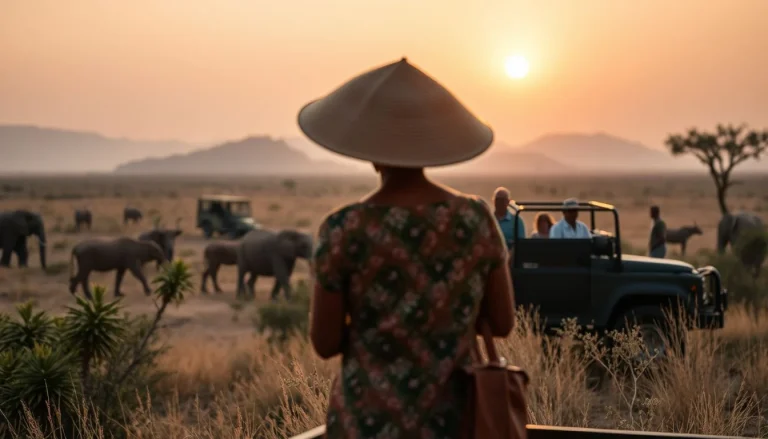
At Jemaa el-Fna, Marrakech’s evening food stalls fill the air with smoke and spice while the High Atlas rises beyond the city. That contrast is the key to planning a first time in Africa: choose one region, one gateway city and one landscape, rather than trying to cover an entire continent in 10–12 days.
This guide is for first-time travellers who want clear choices without reducing Africa’s enormous variety to a single itinerary. Compare seven manageable pairings—from Cairo and Giza to Cape Town and Stellenbosch, Nairobi and the Masai Mara, or Stone Town and Zanzibar—then use the practical framework to decide how to arrive, check entry and health requirements, arrange transport, get connected and book a safari with confidence.
Quick answer: For a first trip to Africa, choose one region, one gateway city and one signature landscape. Strong 10–12-day combinations include Marrakech and the High Atlas, Cape Town and Stellenbosch or the Cape Peninsula, Nairobi and the Masai Mara, Stone Town and Zanzibar, Cairo and Giza, Tanzania’s Serengeti or Ngorongoro, and Victoria Falls.
The places: seven manageable first-trip combinations
The right first trip is shaped less by the number of countries than by the rhythm of the days. Choose one gateway city, one nearby or well-connected landscape, and enough time to settle in before moving on. That gives a 10–12-day journey a clear arc: arrival, orientation, a major landscape, then a calm final base rather than a sequence of airports.
| Combination | Strongest appeal | Transfer complexity | Best suited to |
|---|---|---|---|
| Marrakech + High Atlas | Food, medina streets and mountain scenery | Low to moderate | First-time city travellers |
| Cairo + Giza | Ancient monuments and Nile atmosphere | Moderate | History-focused travellers |
| Cape Town + Stellenbosch or Cape Peninsula | City, coast and mountain in one base | Low to moderate | Independent travellers wanting variety |
| Nairobi + Masai Mara | Urban arrival followed by guided wildlife viewing | Moderate | First-time safari travellers |
| Stone Town + Zanzibar beaches | Swahili heritage and Indian Ocean coast | Low to moderate | Travellers wanting a gentler pace |
| Serengeti or Ngorongoro + Tanzanian gateway | A trip built around wildlife | Moderate to high | Safari-first travellers |
| Victoria Falls | One dramatic natural landmark | Low if staying on one side | Short, landscape-led trips |
Marrakech and the High Atlas

At dusk, Jemaa el-Fna changes character: smoke rises from food stalls, drums carry across the square and the medina narrows into a pattern of lanterns, tiled courtyards and spice shops. Use Marrakech Menara Airport as the gateway, spend several days learning the city’s pace, then trade red-walled lanes for a High Atlas day trip or overnight stay.
This is a strong introduction for travellers who want culture and landscape without building a safari around the trip. Keep the mountain outing flexible and check current Morocco entry rules on the official government or immigration website before booking.
Cairo and Giza

Near Giza, the light on the Nile turns silver before the pyramids take on their familiar outline; across Cairo, minarets, traffic and evening food stalls create a much louder first impression. Cairo International Airport is the practical gateway, with Giza providing the signature landscape and monument rather than requiring a separate domestic journey.
A pre-booked guide can make the first visit more navigable, particularly when combining Giza with museums, historic Cairo and a Nile-side evening. Egypt’s official e-visa portal says passports must be valid for at least six months on arrival; check the portal for your nationality and current entry process before departure.
Cape Town and Stellenbosch or the Cape Peninsula

Table Mountain gives Cape Town an immediate sense of direction: it rises above the city while the V&A Waterfront opens towards the harbour and the Atlantic. Add a day in Stellenbosch or along the Cape Peninsula, and the trip moves naturally between mountain views, coastal roads, neighbourhood restaurants and vineyard country without changing your main base repeatedly.
This is among the more straightforward choices for an independent first-timer, although day-trip transport still needs planning. South African visa rules and exemptions depend on nationality and are listed by the South African Government; SIM registration and passport requirements may also apply. Vodacom’s travel SIM guidance confirms that registration requirements can apply, so check the current airport or provider process rather than assuming a passport-free purchase.
Nairobi and the Masai Mara
Nairobi works as a useful city gateway before the open grassland of the Masai Mara. The contrast is the point: a morning can begin with coffee, traffic and a city skyline, then shift to a guided drive where the road becomes red earth and the horizon is broken by acacia trees.
Allow roughly two or three nights in the reserve instead of trying to fit wildlife viewing into a single rushed excursion. This is a good first safari shape because a reputable operator can coordinate vehicles, accommodation and the journey from Nairobi; verify Kenya’s current entry process and travel advisories before committing to dates.
Stone Town and Zanzibar beaches

Stone Town introduces Zanzibar through carved wooden doors, shaded lanes and the clove-scented air around its old streets. After the city, move to a beach base for slower mornings beside the Indian Ocean, leaving room for the fact that island transfers and ferry or flight connections do not always fit neatly around an international arrival.
Confirm the current flight or ferry logistics, Tanzania entry rules and any requirements connected to your route of origin. Tanzania publishes e-visa guidance through its official Immigration Services website, while yellow fever requirements can depend on the countries visited or transited; check current destination guidance and the WHO country information before travelling.
Serengeti or Ngorongoro and a Tanzanian gateway
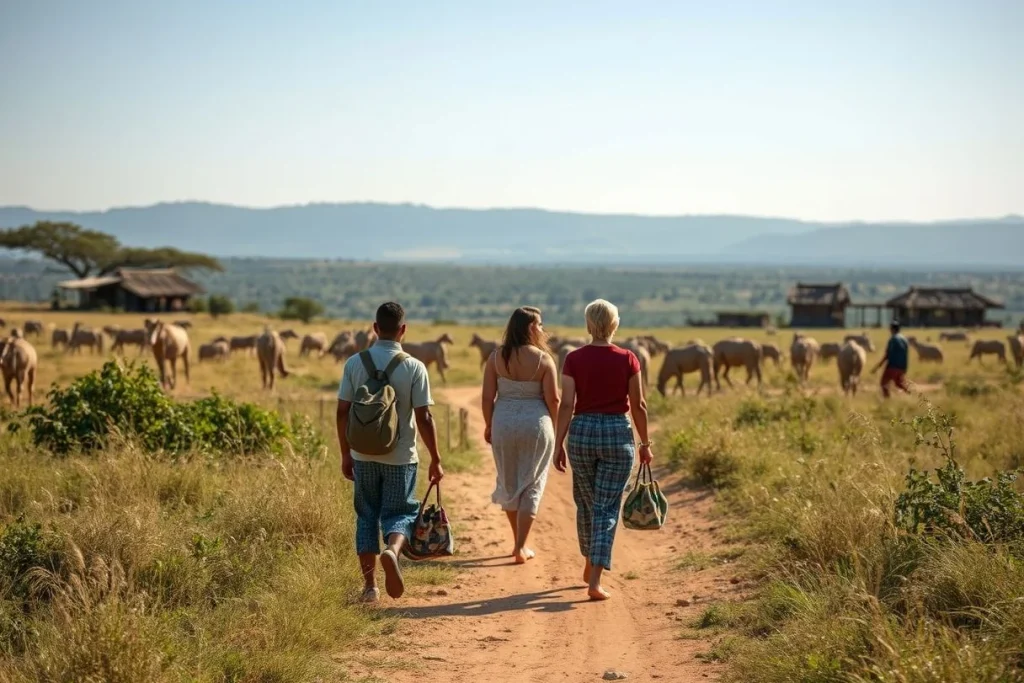
Choose this route when wildlife is the main reason for going. In the Serengeti, dawn begins over long grassland and distant kopjes; in Ngorongoro, the enclosed crater landscape gives a safari a different visual rhythm. A Tanzanian gateway city is mainly a practical arrival point, so avoid spending precious days adding several urban stops.
Safari logistics matter more here than ambitious sightseeing: transport, park access, accommodation and permits need to align. Reserve early for busy periods such as June to August or December, and use Tanzania’s official e-visa guidance rather than a third-party visa seller. A travel-health professional should also advise on malaria prevention for the exact itinerary; the CDC Yellow Book provides country-specific information.
Victoria Falls from Victoria Falls town or Livingstone
Victoria Falls is a useful choice when one great landscape is enough. Spray hangs over the river, the sound arrives before the full view and the surrounding paths turn a short visit into a vivid few days. Base yourself first in Victoria Falls town or Livingstone rather than trying to cross the border immediately after a long-haul flight.
Adding both sides can work, but it introduces another set of entry, transport and park-fee checks. Confirm visa and cross-border requirements for your passport and chosen base before booking; country-specific travel advisories are updated regularly and should be checked both before purchase and before departure.
When to go

Season should follow the region, not a continent-wide calendar. East African safari planning commonly focuses on June–October, while Southern African wildlife trips often favour the drier May–September period. Cape Town’s beach conditions suit November–March more closely, and North African city or desert travel is generally more comfortable from September–May.
These are planning windows, not guarantees. Recheck local weather, park access, road conditions and closures close to departure, particularly if your route depends on one safari area or a cross-border visit. The choice is simplest when the season, gateway and signature landscape all point in the same direction.
Making it happen: a simple 10–12-day Africa travel plan
Planning your first trip to Africa becomes much easier when every decision serves the same route. Choose one region, one gateway city and one signature landscape; then build a trip with enough space for arrivals, transfers and the occasional delay. The following sequence works for a 10–12-day journey without pretending that Marrakech, Cape Town, Nairobi and Zanzibar require the same preparation.
Choose the combination that matches your travel style. For culture and mountains, pair Marrakech with the High Atlas. For ancient history, choose Cairo and Giza. Cape Town with Stellenbosch or the Cape Peninsula suits travellers who want a city, coastline and scenery in one base. Nairobi and the Masai Mara are the clearest choice for a first safari, while Stone Town and Zanzibar work for a slower city-and-coast trip. A safari-first journey can focus on the Serengeti or Ngorongoro, and Victoria Falls is a strong option when one dramatic landscape matters more than covering several destinations.
Resist adding a second country simply because it appears close on a map. Border crossings, internal flights and park transfers consume real holiday time. Add another country only when the flight routing is genuinely simple and the extra stop replaces, rather than crowds, part of the main experience.
Sketch a low-stress 10–12-day rhythm. Allow two or three nights in the gateway city, four or five nights around the signature landscape, and one buffer night before the return flight. That leaves room for a first-night recovery after a long-haul journey and avoids making a missed connection threaten the journey home.
Safari transfers are not ordinary city excursions: vehicles, park gates, accommodation and roads all shape the day. Domestic flights can also involve airport changes, baggage limits or a night near the departure point. Treat travel days as part-days, not as empty spaces into which another major sight can be fitted.
Route the arrival before booking the details. The main gateways for these combinations include Marrakech Menara Airport, Cairo International Airport, Cape Town International Airport, Jomo Kenyatta International Airport in Nairobi and Johannesburg’s OR Tambo International Airport. Addis Ababa Bole, Cairo and Casablanca also appear among the more connected African airports in OAG’s 2026 Megahubs coverage. That makes them useful routing points, but connectivity is not a promise of the cheapest fare, the shortest journey or a convenient onward connection.
Compare the complete route rather than only the headline flight: arrival time, airport changes, baggage rules, overnight connections and the distance between the airport and your first accommodation. For a first trip, a slightly less ambitious itinerary with one clear arrival airport is usually worth more than a clever-looking series of connections.
Make the first evening deliberately simple. After immigration and baggage collection, follow signs to the official taxi rank or use a pre-booked airport transfer. Avoid accepting transport from people who approach inside or just outside the terminal. Save the accommodation address offline, including its local-language spelling if available, and keep the booking confirmation accessible without mobile data.
Do not schedule a late city tour, long road journey or early safari immediately after a long-haul arrival unless the logistics leave a generous margin. Your first useful tasks are modest: reach the accommodation, drink water, confirm the next morning’s plan and learn how the local payment system works.
Check visas and documents for your passport and route. There is no single “Africa visa” rule. Requirements depend on nationality, destination, transit country, passport validity and sometimes the route taken before arrival. Use the destination government’s immigration or e-visa website, not a search advert or an unofficial visa seller.
For Egypt, the official e-Visa Portal states that a passport must be valid for at least six months on arrival. Tanzania provides its own official e-visa guidance, while South African requirements and exemptions are listed on the South African Government visa page. These are examples, not general permission to assume visa-free entry or visa on arrival elsewhere.
Keep a digital and paper copy of your passport, insurance details, bookings and any approval or receipt. Check the official immigration site again before departure, particularly if you change a transit airport or add a second country.
Arrange health advice early. Book a travel-health appointment well before departure, taking the exact countries, parks, islands and transit points with you. Some countries require a yellow fever certificate from travellers arriving from, or transiting through, specified countries; the current requirement should be checked against destination guidance and the WHO country information.
The CDC Yellow Book’s country-by-country guidance covers yellow fever vaccination and malaria prevention. Malaria advice depends on the exact destination and itinerary, so discuss tablets, bite prevention and any other recommended measures with a qualified travel-health professional rather than treating the continent as one medical category.
Prepare money and connectivity in layers. Carry a small reserve of arrival cash, a backup card and a note of your bank’s emergency number. Tell your bank where you are travelling, and ask your accommodation which ATMs and payment methods are normally trusted nearby. Do not keep every card and all your cash in the same wallet.
A local SIM or eSIM can make airport transfers, maps and accommodation contact much easier, but registration may require a passport. In South Africa, Vodacom’s travel SIM information notes that registration and passport requirements may apply. In East Africa, research the specific country’s Safaricom and M-Pesa arrangements before relying on mobile money; services, registration and payment norms are not identical across borders.
Match each type of transport to the route. Use pre-booked transfers or official taxi ranks for airport arrivals, reputable ride-hailing where it operates, and established rail or ferry services for journeys that suit them. Confirm the meeting point and the driver’s name before leaving the terminal. For Zanzibar, check current flight or ferry logistics rather than assuming that a mainland connection will line up neatly.
For the Masai Mara, Serengeti, Ngorongoro, Amboseli, Ol Pejeta or Victoria Falls area, use a reputable safari or activity operator and ask what is included: park permits, vehicle, guide, accommodation, transfers and border arrangements. Book sought-after wildlife accommodation and transport early for busy periods in June, July, August and December, then confirm current park rules and access close to departure.
Travel with courtesy and a verification habit. Dress with extra care at mosques, churches and other religious sites, and ask before photographing people, ceremonies or rural communities. Keep phones and cash out of sight when they are not needed, use official guides and transport, and leave copies of important documents with someone at home.
Pause when an unofficial taxi offer, a sudden “guide”, an inflated currency exchange, unsolicited help at an ATM or a distraction around your bags appears. These are scam patterns to verify, not reasons to stereotype an entire country or city: step away, use the official counter or taxi rank, check the amount yourself and ask your accommodation for local advice.
Security conditions vary sharply by country and region. Read the relevant country-specific travel advisory before booking and again before departure, alongside the destination government’s notices. Avoid making a late route change based on a general social-media post when an official update is available.
A workable city-and-safari rhythm might be three nights in Nairobi, two travel days and four nights around the Masai Mara, followed by a buffer night before flying home. A city-and-coast version could use three nights in Stone Town, four or five nights on Zanzibar’s coast, one transition night if needed and a final night near the departure airport. The exact order depends on flight schedules, but the principle remains constant: fewer bases, protected transfer days and one landscape given enough time to settle into.
Conclusion: start with one region, not the whole continent
For a first trip to Africa, choose the pairing that matches the experience you want rather than trying to represent the whole continent. Pick Marrakech and the High Atlas for medina life and mountain air; Cape Town and the Cape Peninsula for an easy city-and-landscape rhythm; Nairobi and the Masai Mara for a guided safari introduction; or Stone Town and Zanzibar for carved doors, spice-scented streets and the coast.
- Choose one pairing and one gateway city.
- Check the destination’s official immigration, health and current travel-advisory pages for your passport and route.
- Draft a 10–12-day plan with one buffer night, especially before an international flight.
Only then book a flexible gateway-city stay or vetted arrival transfer. That small amount of structure turns “first time in Africa where to start” from a continent-sized question into a trip you can plan with confidence.
Frequently asked questions
Is it better to begin with a city, a safari or a beach destination?
For a first trip, a city-plus-landscape pairing is the easiest way to understand the scale and variety of Africa without crossing several regions. Choose Marrakech with the High Atlas, Cape Town with Stellenbosch or the Cape Peninsula, or Cairo with Giza if you want independent sightseeing and straightforward day trips. Choose Nairobi with the Masai Mara, Tanzania’s Serengeti or Ngorongoro, or Stone Town with Zanzibar if one main experience—wildlife or the coast—matters more than a broad introduction. Seasonal fit matters: East African safaris commonly focus on June–October, while Cape Town’s beaches suit November–March; check current local conditions before booking.
Can I travel alone on a first African trip, or should I join a group?
Solo travel is possible, but the right level of support depends on the route rather than on the continent as a whole. A city stay can be arranged independently, while a safari in the Masai Mara, Serengeti, Ngorongoro or around Victoria Falls is usually simpler to organise with a reputable operator, particularly when transport, park access and accommodation must align. Check current country- and region-specific travel advisories before booking and again before departure; the US Department of State notes that advisories are destination-specific and regularly updated.
How much luggage is practical when combining flights, safari and city stays?
Pack for movement rather than for every possible climate: one manageable main bag and a small day bag are more practical than several suitcases when a trip combines regional flights, guided safari transport and city hotels. Keep documents, medication, valuables and one change of clothes in the day bag, and confirm the baggage allowance for every flight before departure. If your itinerary joins a cool city, a warm coast and a safari, use light layers and leave space for items that must stay accessible during transfers.
What should I pack for changing climates and conservative dress expectations?
Build the wardrobe around layers, breathable fabrics and clothing that covers shoulders and knees when visiting religious sites, traditional neighbourhoods or more conservative communities. A light outer layer is useful for cooler mornings and evenings, while sun protection and comfortable closed shoes suit city walking and safari days. Health preparation is destination-specific: the CDC Yellow Book provides country-by-country yellow fever and malaria guidance, and its malaria advice should be discussed with a qualified travel-health professional before departure.
How far in advance should I reserve a first-time safari or popular park stay?
Reserve the safari part before fixing the rest of the itinerary, especially for travel in June, July, August or December. The planning brief recommends booking park transport and accommodation early during busy periods, and a two- or three-night Masai Mara stay gives a more workable rhythm than trying to fit wildlife into a single rushed day. Ask the operator to confirm current permits, park rules, transfers and any seasonal access changes rather than relying on an old itinerary.
What is the best way to stay in touch with family while travelling between regions?
Use a local SIM or an approved travel SIM where available, and save your accommodation, transfer and operator details offline before leaving the airport. In South Africa, Vodacom offers travel SIMs and bundles, but its published terms indicate that registration and passport requirements may apply; check the provider’s current rules before arrival. Keep a second communication option, such as hotel or operator contact details, for journeys beyond reliable mobile coverage, and tell family when you expect to move between cities or safari areas.