The A2 carries drivers south from Lisbon towards the Algarve, linking the capital with the region’s motorway corridor before the A22 divides the journey between western towns such as Lagos and the Faro–Tavira area. A direct Portugal road trip Lisbon to Algarve is realistic in one day, but the route becomes more rewarding when you decide whether the priority is arrival or atmosphere.
This guide is for couples who want scenic stops, walkable old centres, atmospheric dinners and enough time to slow down. It compares the fast motorway transfer with detours through Setúbal and Arrábida, Comporta or Évora, then weighs Lagos against Tavira as an Algarve base. You’ll also find the practical details that can disrupt an otherwise easy drive: electronic tolls, rental-car conditions, parking and realistic leg times.
Quick answer: Driving directly from Lisbon to the central Algarve via the A2 and A22 usually takes about 2.5–3 hours in normal traffic, so a one-day transfer works. Add Setúbal/Arrábida, Comporta or Évora if you have time; choose Lagos for western cliffs and sunset outings, or Tavira for a quieter historic-centre atmosphere.
Portugal road trip from Lisbon to the Algarve: route, time and ideal pace
The useful distinction is not simply north versus south, but speed versus atmosphere. The direct Lisbon to Albufeira or central Algarve journey is approximately 252–260 km by road and usually takes about 2.5–3 hours in normal traffic, according to route estimates from Rome2Rio. That makes driving from Lisbon to the Algarve in one day realistic, especially if you want to spend more time settled into one Algarve base.
The quickest route follows the A2 Autoestrada do Sul before joining the A22 Via do Infante. The A2 is the principal motorway south from Lisbon; the A22 then runs east–west across the Algarve, linking the Lagos, Portimão and Faro areas. This is the practical choice for couples arriving after a flight, travelling with limited holiday time or carrying luggage they would rather not move between hotels.
For a slower Portugal road trip itinerary, allow two or three stops. Setúbal and the Arrábida coast make a useful first night, with seafood and coastal scenery; Comporta suits couples who want a quieter beach-oriented pause. Évora takes the route inland into the Alentejo, where the historic centre, Roman temple, wine and unhurried dining change the mood before the Algarve.
Coastal and local roads can make the journey more scenic, but they are slower than the motorway route and require more attention to exact routing. Build the trip around one substantial stop rather than trying to combine every detour in a single day. For the final base, choose Lagos for western cliffs and sunset outings, or Tavira for a calmer historic-centre atmosphere.
Car hire and road conditions: licences, tolls and driving culture
A valid foreign driving licence is generally accepted for driving in Portugal, including licences written in Latin script. If your licence uses a non-Latin alphabet, check with both gov.pt and the rental company before travelling: an International Driving Permit or certified translation may be required, depending on the circumstances. Carry your passport or another accepted form of identification; Portuguese police may ask you to prove your identity, according to GOV.UK Foreign travel advice, updated 30 September 2026.
Check the rental conditions as carefully as the headline rate. Age limits vary by supplier and vehicle category; many companies set a minimum age around 21 and add a young-driver surcharge below 25, while premium cars may have a higher minimum. Confirm the excess, insurance exclusions, additional-driver charge and airport collection arrangements before paying.
Motorways, local roads and tolls
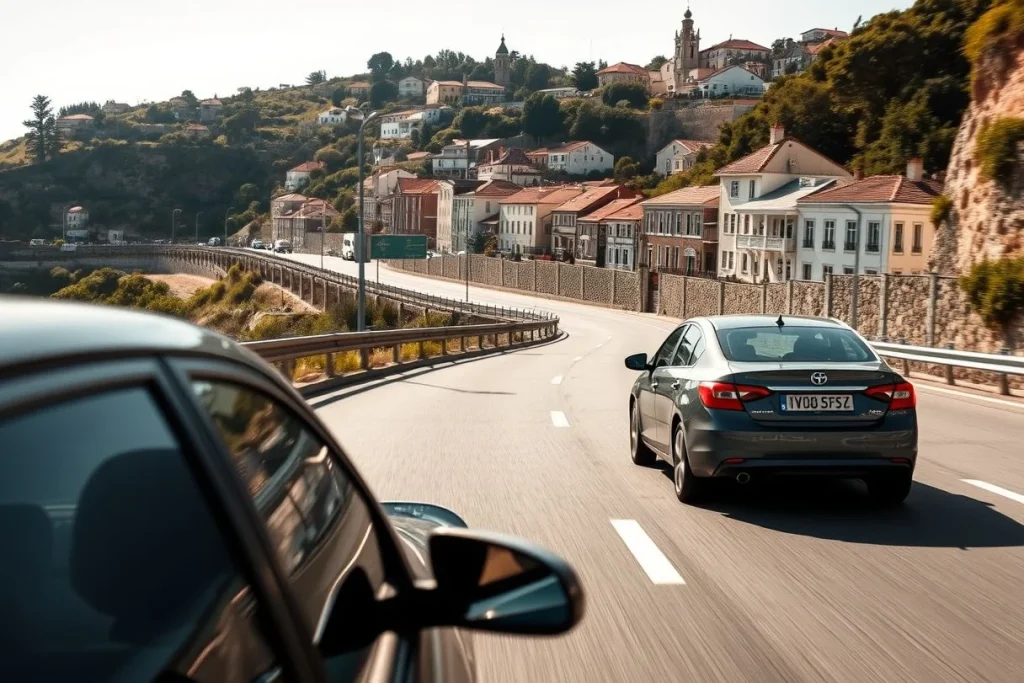
For a direct transfer, the A2 south from Lisbon followed by the A22 in the Algarve is the practical choice. It is generally faster and simpler than scenic coastal or secondary roads, which take longer and demand more attention to junctions, surfaces and exact navigation. Driving style is separate from the legal rules: follow posted limits and signs, and allow extra concentration when leaving the motorway for smaller roads.
Do not assume that every toll can be paid in cash. Portugal has electronic-only motorway sections. Arrange payment before setting out through Via Verde Visitors, or confirm that the rental company has supplied or activated a toll transponder. Ask how its fees are charged and when they appear on your card. Infraestruturas de Portugal notes that post-payment routes such as CTT, Payshop or a Multibanco reference may be available in some cases, but foreign-plate rules can vary. Treat this as a fallback to verify, not a plan: missed tolls can bring fines, surcharges and rental-company administration fees.
Stop by stop: Lisbon to the Algarve with scenic overnight options
Day 0 is the southbound set-up for this Portugal road trip: collect the car only when leaving Lisbon, then choose between a direct Algarve transfer and a more atmospheric overnight in Setúbal, Comporta or Évora. Alfama and Bairro Alto are easier without a car, so keep the vehicle at Humberto Delgado Airport or an airport-area depot until the city stay is over.
Morning
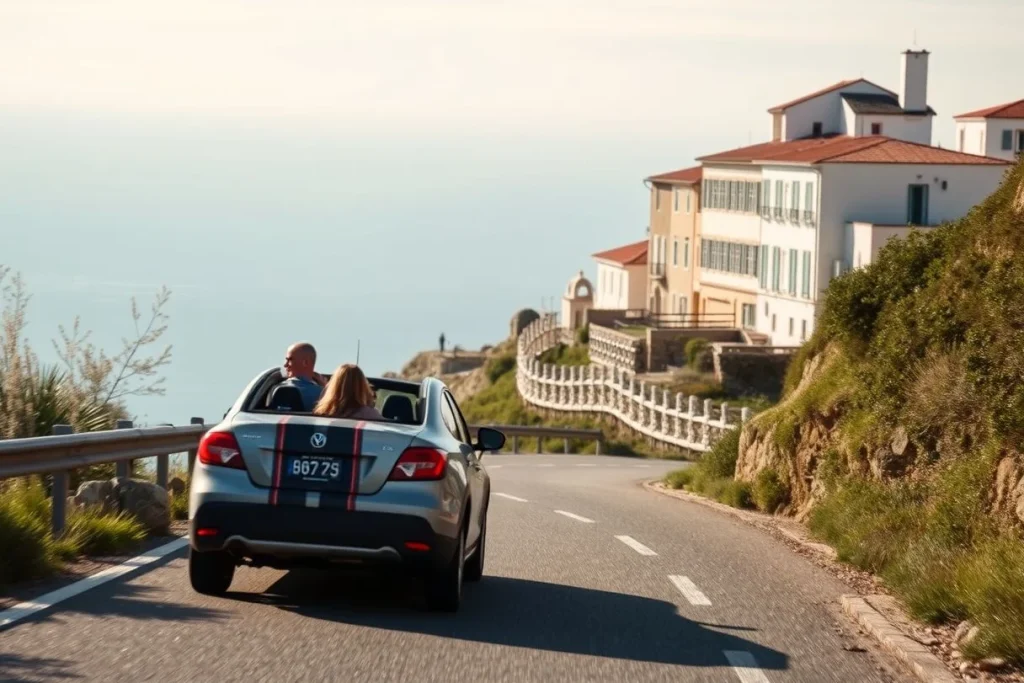
If time is limited, make this a transfer day. Collect the car at Lisbon Airport, allow time to inspect the vehicle and confirm the toll arrangement, then follow the A2 south before joining the Algarve motorway corridor. The direct motorway route to Albufeira or the central Algarve is typically about 2.5–3 hours in normal traffic, according to route estimates compiled by Rome2Rio; traffic leaving Lisbon and summer congestion can extend that considerably.
This is the cleanest choice for couples who want more time beside the sea. Continue to Lagos, Alvor, Portimão, Faro or Tavira rather than adding a stop simply to break up the drive. The A22 Via do Infante connects the main Algarve towns from the Lagos area towards Faro and the east, making it practical to choose the base that best suits the rest of the holiday.
Afternoon
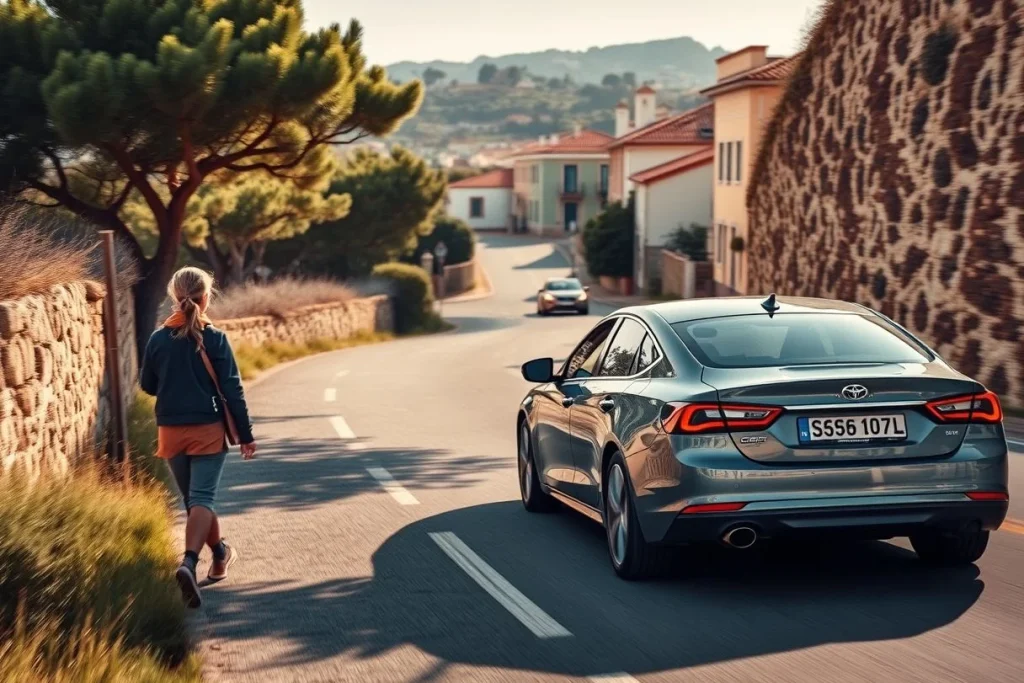
For a gentler first day, take the Setúbal option. Lisbon to Setúbal typically takes 45–60 minutes, while Setúbal to Évora is usually about 1–1.5 hours; the estimates depend on the exact start point, route and traffic. Setúbal works well for a seafood lunch, a harbour stroll and a scenic outing towards Arrábida Natural Park and Portinho da Arrábida. Coastal and local roads are slower than the motorway, so this is a deliberate detour rather than a faster route south.
Stay in Setúbal or near Arrábida if you want a sea-facing beginning to the trip. Check the accommodation’s parking arrangements before booking: a small central property may be more atmospheric, but a car-friendly location can save hassle overnight. Access and parking around beaches can change seasonally, so check local conditions before setting out.
Comporta is the quieter alternative. Choose it for a beach-led afternoon, a boutique-style overnight and an unhurried dinner rather than for sightseeing variety. It is best treated as its own coastal pause; do not combine it with Setúbal, Arrábida and Évora in the same day unless you are comfortable spending much of the daylight in the car.
Évora takes the route inland. Its UNESCO-listed historic centre, Roman temple, wine culture and Alentejo dining make it the strongest choice for couples who prefer stone lanes and a long dinner to a first taste of the coast. From Évora to Lagos, allow roughly 2–2.5 hours according to the supplied route estimates. That makes Évora a sensible overnight between Lisbon and the western Algarve, but a less direct choice for Tavira.
Evening
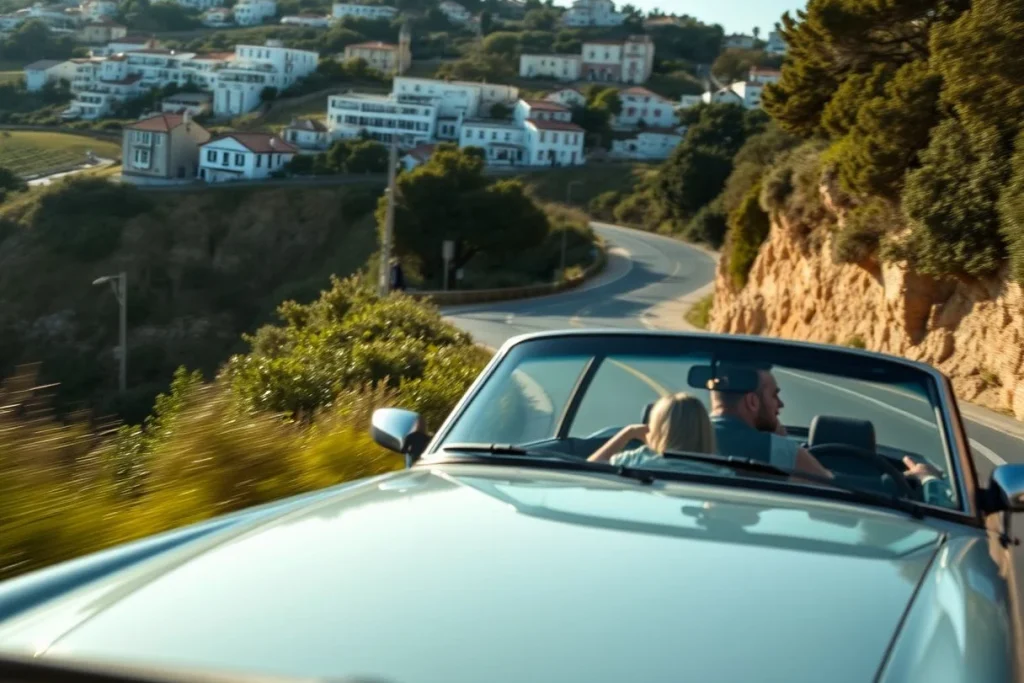
Arrive at the Algarve base with time left for a walk rather than another attraction. Lagos suits couples who want a walkable old town, cliff scenery around Ponta da Piedade and easy sunset outings. Alvor or Portimão are useful compromises for coastal time with a different base, while Faro combines an old town with access to the Ria Formosa Natural Park.
Tavira is the calmer eastern choice: stay here for a historic centre, slower evenings and a more intimate atmosphere. It is especially appealing after a direct drive if the priority is settling into one place. From Lagos to Faro, the typical drive is about 1–1.25 hours, so changing from a western to an eastern base later is possible, but it is usually better to choose one side rather than spend the holiday retracing the Algarve.
Where to eat

In Setúbal, look for locally caught fish and seafood. Comporta suits a late lunch or relaxed dinner after the beach. Évora is the place for Alentejo dishes, regional wine and a longer evening around the historic centre. In Lagos and Alvor, choose grilled fish, shellfish or cataplana; in Tavira and Faro, seafood and dishes influenced by the Ria Formosa fit the setting. Ask the hotel to reserve a table if arriving on a summer weekend.
Getting around
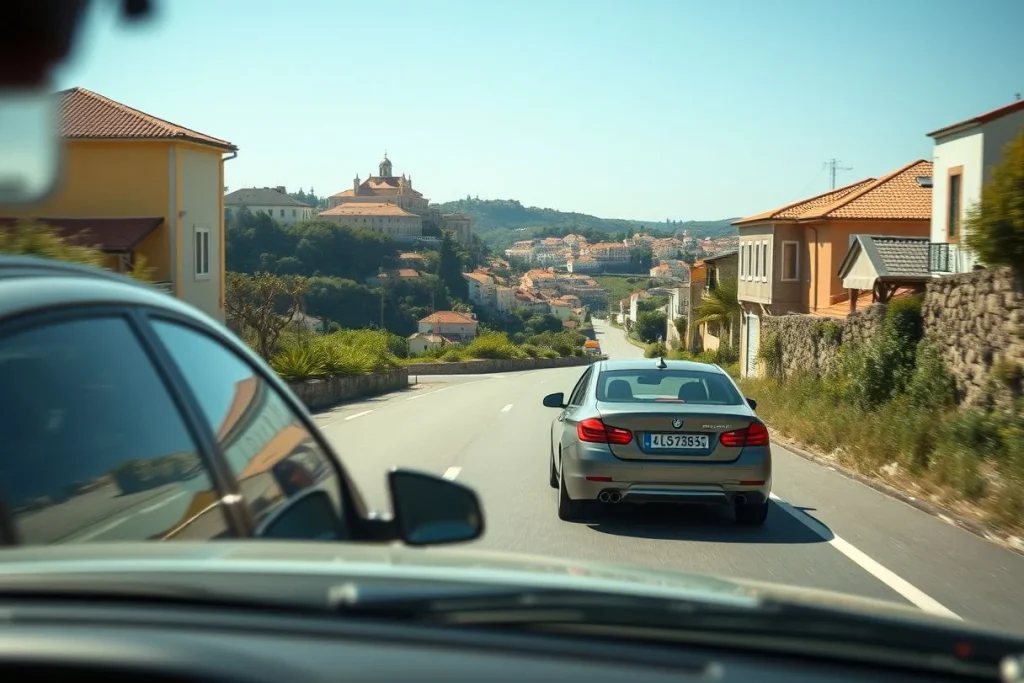
Use the A2 and A22 when the priority is time, and local or coastal roads when the stop itself is the point. Many motorway sections use electronic-only tolling. Via Verde Visitors offers a visitor payment option, while rental companies may provide a transponder. Confirm the arrangement before leaving Lisbon and check the current route cost with Infraestruturas de Portugal.
A valid foreign licence is generally accepted, but gov.pt advises checking requirements for non-Latin-alphabet licences and any certified translation or International Driving Permit. Rural and secondary roads require more care after dark, particularly where slow farm vehicles or livestock may be present.
Estimated time
- Direct Algarve transfer: about 2.5–3 hours of driving, plus vehicle collection, a meal and a relaxed evening.
- Setúbal or Comporta: a short first drive, with the remaining southbound journey on the following day.
- Évora overnight: about 1–1.5 hours from Setúbal if combining stops, then 2–2.5 hours to Lagos the next day.
- Allow extra time: in July and August, when traffic, accommodation demand and Algarve parking pressure are higher.
Optional extras
- For a coastal start: replace Évora with Setúbal and Arrábida, but check beach access and parking before departure.
- For a slower couple’s trip: spend the night in Comporta and continue south the next morning.
- For a quieter Algarve base: choose Tavira and reserve time for the Ria Formosa Natural Park rather than adding several western Algarve stops.
Lagos or Tavira for couples: western drama or eastern calm?
The choice comes down to atmosphere rather than distance. Choose Lagos for a first Algarve visit built around a walkable old town, sunset outings and the cliffs of Ponta da Piedade. Choose Tavira for quieter historic-centre evenings, slower dinners and access towards the Ria Formosa Natural Park and the eastern Algarve.
| Base | Atmosphere and scenery | Evening walkability | Excursion style | Parking and airport positioning |
|---|---|---|---|---|
| Lagos | Western Algarve energy, dramatic cliffs and Ponta da Piedade | Strong around the old town | Coastal viewpoints, sunset outings, beaches and boat-based sightseeing | Check parking when booking; around 1–1.25 hours from Faro by typical road estimate |
| Tavira | Quieter historic centre and eastern Algarve character | Particularly suited to relaxed evening walks | Ria Formosa and slower eastern-Algarve exploring | Choose accommodation with confirmed parking if arriving by car; farther east than Faro |
| Faro | Historic old town with practical access to the Ria Formosa | Good for a compact final evening | Airport logistics, old-town wandering and a natural-park detour | The practical compromise for an early Faro Airport departure |
Lagos suits couples who want the destination to provide a ready-made rhythm: walk out for dinner, return through the old town and leave the next day for Ponta da Piedade or nearby coastal stops. If Lagos feels too activity-led, Alvor and Portimão are useful western Algarve alternatives, particularly for adding coastal time without changing region.
Tavira is the better match when the pleasure is in an unhurried historic centre and a romantic evening rather than a packed sightseeing schedule. It also makes more sense for a route that continues towards the eastern Algarve or the Ria Formosa. Neither base removes the need to check accommodation access: historic-centre streets and seasonal demand can make a parking-filtered search worthwhile.
For the simplest departure, sleep in Faro rather than forcing a long final transfer from Lagos or Tavira. The fastest Lisbon-to-Algarve routing uses the A2 and A22, but once you have chosen a western or eastern base, allow the drive to serve the mood of the trip: cliffs and activity in Lagos, or calm streets and slower dinners in Tavira.
Best time for this Lisbon-to-Algarve drive: May to June or September to October
For most couples, the best time for a Portugal road trip from Lisbon to the Algarve is May to June or September to October. These periods usually offer warm conditions, thinner crowds and less peak-season pressure, making it easier to pause in Setúbal, find parking near coastal viewpoints and book a characterful stay without building the itinerary around summer demand. Late spring and early autumn are also the most balanced seasons for combining driving with evenings outdoors, according to the 2026 road guide from Driving Directions and Maps.
| Period | Weather feel | Crowds and roads | Best use and trade-off |
|---|---|---|---|
| May–June | Generally warm | Thinner than peak summer | Strong all-round choice for coastal stops and relaxed dinners; check local event dates. |
| July–August | High-summer conditions | Busiest period, with heavier traffic, greater accommodation demand and tighter parking in Algarve towns | Choose it for a classic beach holiday, not for an unhurried driving itinerary. |
| September–October | Generally warm | Less peak-season pressure | Excellent for Lagos cliffs, Tavira evenings and a slower route; some seasonal services may vary. |
| December | Check conditions for your dates | Treat as a peak-demand period for this destination brief | Useful for a festive break, but check accommodation demand and event programming separately. |
July and August suit couples who prioritise long beach days over flexible parking and quiet roads. If travelling then, allow extra time at Algarve towns and coastal stops rather than scheduling several fixed viewpoints in one day. December also deserves separate planning: festive demand can make it busier than its winter position suggests.
Event dates change by year. Confirm festivals, concerts, road closures and seasonal access through the relevant official tourism or event source before booking, and compare accommodation rates across several dates if your schedule is flexible.
Portugal road trip costs for two: 2026 budget, mid-range and luxury planning
For a couple, a Portugal road trip from Lisbon to the Algarve can be planned at several price levels, but these are 2026 market snapshots, not guaranteed quotes. The daily figures include accommodation, car hire and typical meals, while major extras can vary.
| Estimated 2026 budget | Rental car | Room per night | Whole trip per couple, per day |
|---|---|---|---|
| Budget | From approximately €18 per day in some low-season advertised deals | €50–100 | €70–120 |
| Mid-range | Approximately €25–60 per day in mid-season | €120–220 | €150–300 |
| Luxury | Price a premium car separately | €300+ | €350+* |
Basis: per rental day, per room per night and per couple per day; figures reflect 2026 guidance from The Portugal Guides. The luxury daily estimate is from 2024–2025 self-drive source material and should be verified against current rates.
For a romantic mid-range trip, the accommodation figure is the main planning anchor: a boutique room in Lisbon, Évora or the Algarve can move the average more than the drive itself. Rental quotes also change with dates and inclusions. Check taxes, insurance and excess, toll-device fees, fuel, parking, an extra driver and any young-driver surcharge before comparing suppliers.
Do not add an assumed toll total. Electronic toll arrangements vary by route and vehicle class, and unpaid charges can attract surcharges and rental-company administration fees. Obtain a live calculation from Infraestruturas de Portugal or check payment terms through Via Verde Visitors before collecting the car.
| Item | Budget | Mid-range | Luxury |
|---|---|---|---|
| Small rental car | From approximately €18 per day in some low-season advertised deals | Approximately €25-€60 per day for a small car in mid-season, depending on supplier, timing and inclusions | Not specified in the source; price a premium car separately |
| Accommodation | Approximately €50-€100 per night | Approximately €120-€220 per night | €300+ per night |
| Whole-trip daily budget for a couple | Approximately €70-€120 per day | Approximately €150-€300 per day | Not supported by this source |
| Luxury whole-trip budget for a couple | — | — | €350+ per day |
Estimated ranges based on the sources listed below. Prices change; check with providers before booking.
Practical driving tips that make the route easier
A few checks before leaving the depot will prevent most avoidable problems on a Lisbon-to-Algarve drive:
- Confirm the collection point. Ask whether the Lisbon Airport or Faro Airport depot is on-site or reached by shuttle, and allow extra time if your flight arrival is late or your return is close to departure.
- Inspect and photograph the car. Record existing marks, the fuel level, mileage and windscreen condition before driving away; make sure both drivers are listed on the agreement.
- Read the cover details. Confirm the insurance excess, roadside assistance, glass and tyre cover, additional-driver fee and any young-driver surcharge. Age and vehicle rules vary by supplier; check the current terms directly.
- Settle toll arrangements at the desk. Many Portuguese motorways are electronic-only. Confirm whether the rental includes a transponder, what administration fee applies, and how charges will be billed. Via Verde Visitors explains visitor payment options.
- Verify the one-way return. Lisbon-to-Faro collection and return is not automatic: confirm availability, the one-way fee and the exact return procedure before paying.
- Download navigation before departing. Save the route offline, then allow extra time in July, August and busy weekends, when Algarve traffic and parking demand increase.
- Plan daylight for rural sections. Secondary roads can be darker and may have livestock or slow farm vehicles at night. Check beach access, parking restrictions and seasonal closures around Arrábida and the Algarve coast.
- Recheck official advice. Before departure, consult GOV.UK’s Portugal advice, updated 30 September 2026, for identification requirements, petty-crime guidance, strikes and demonstrations.
The best final choice for your couple’s Algarve road trip
Choose Lagos if this is your first Algarve visit and you want dramatic western scenery, the cliffs around Ponta da Piedade and easy sunset outings. Choose Tavira if a quieter, more romantic historic-centre base matters more than coastal drama. Its eastern setting also suits couples planning time around the Ria Formosa.
If the journey itself is part of the holiday, add one intermediate night in Setúbal, Comporta or Évora rather than driving straight south. Otherwise, the A2 and A22 make the transfer to the Algarve realistic in one day. Decide first between Lagos and Tavira, then choose your dates; finally check live hotel availability, rental terms and toll arrangements for the exact route.
Frequently asked questions
Is it easy to find parking in Lagos and Tavira?
Parking availability in Lagos and Tavira varies by exact address, season and local restrictions; the supplied sources do not support a reliable general promise. Before booking, ask the accommodation about a private space or nearby public parking, then check municipal or official tourism information for current access rules, especially in July and August when Algarve demand is higher.
Which Algarve town is better for a first visit: Lagos or Tavira?
Choose Lagos for a first Algarve visit centred on a walkable old town, sunset outings and the cliffs around Ponta da Piedade. Choose Tavira if you prefer a quieter historic-centre atmosphere and access to the eastern Algarve and Ria Formosa area. For couples wanting dramatic coastal scenery, Lagos is the more natural fit; for slower evenings, Tavira has the advantage.
Are coastal roads worth taking instead of the motorway?
They can be, if the drive itself is part of the holiday and you have time for pauses. The A2 and A22 are generally the fastest route, while coastal and local roads are slower but support a more scenic itinerary, according to Driving Directions and Maps. Use the motorway for a transfer day; take coastal roads selectively rather than trying to make the whole journey scenic.
Can I include Comporta and Évora on the same southbound journey?
Yes, but it works better as a two-stop journey than as a rushed detour. Comporta suits a slower coastal overnight, while Évora offers an inland Alentejo stay with a UNESCO-listed historic centre, Roman temple, wine and unhurried dining. Typical estimates are Setúbal to Évora about 1–1.5 hours and Évora to Lagos about 2–2.5 hours, before local diversions.
Is the Algarve suitable for a short car-free stay after the road trip?
Yes, if you finish in a walkable base and plan activities locally. Lagos offers a walkable old town and access to Ponta da Piedade, while Tavira suits couples seeking a historic centre and quieter evenings. Faro is practical for an airport departure and the Ria Formosa area. For a wider Algarve itinerary, keeping the car is more flexible; confirm local transport for each planned outing.
What should couples book in advance for this route?
Prioritise accommodation with confirmed parking, particularly for stays in Lagos, Tavira and other Algarve towns during July and August. Reserve a rental car early enough to compare insurance excess, toll-transponder terms, age rules and one-way fees; live conditions vary by supplier. If using motorways, arrange toll payment through the rental company or Via Verde Visitors and verify the current process before driving.